Hey, Let's Bash Toyota
By AL LEWIS
BP's Tony Hayward drove Akio Toyoda's runaway cars off the 24-hour news cycle. But now that BP's hole is plugged, it's time to start wailing on Toyota again.
Last week, Toyota revealed that a federal grand jury in New York has subpoenaed documents, potentially widening probes from stuck accelerators to snapping steering rods.
Don't you just love what we do to Toyota? Why can't we do this to everybody?
Drag the CEO all the way from Japan, shove him before Congress, and make him cry.
Slap the company with the highest possible fine. Sue it hundreds of times. Convince it to recall models by the millions. Make it apologize repeatedly. (Bow more fully for the cameras next time, Mr. Toyoda.)
Transportation Secretary Ray LaHood once warned Americans not to drive Toyotas. Can you imagine the Treasury secretary warning Americans not to use Goldman Sachs? And why didn't Congress make Mr. Hayward cry? The closest he came to tears was when he whined, "I want my life back," and then got back on his yacht to sail the less poisoned part of the ocean.
So now it's time to beat on someone else. Remember Big Tobacco? How about Big Toyota?
Toyotas can take off as if possessed by Onibaba, the Japanese demon hag. OK, so as investigations continue, it's looking like many accidents were caused by drivers who don't know the difference between the gas pedal and the brake. But Toyotas may have other problems, too.
Toyota hasn't always been forthright. And it's illegal to mislead regulators about safety defects in cars. Not that other auto makers haven't done it. But there has never been a better time to pile on criminal charges.
Toyota bashing helps Americans forget GM's bumbling former CEO Rick Wagoner and Chrysler's former mis-manager Bob Nardelli. It also gets voters' minds off former Countrywide CEO Angelo Mozilo's special loans to his friends, or Goldman Sachs CEO Lloyd Blankfein's shrewd decision to have the bank settle with the Securities and Exchange Commission for $550 million. And the systemic fraud alleged at America's biggest banks, a mind-blowing national debt and double-digit unemployment after corporations shipped millions of jobs abroad.
Toyota bashing makes it look like our leaders are actually trying to save America.
"All the Toyota vehicles bear my name," Mr. Toyoda has repeatedly lamented, which is true except that I think someone in the marketing department misspelled it a long time ago and never fixed it.
"When the cars are damaged, it is as though I am, as well."
I don't know if Mr. Toyoda is contrite, or if he's just another grief-feigning narcissist whose grandfather gave him a car company. But I was heartened when he went before Congress in February and said this:
"I fear the pace at which we have grown may have been too quick.... Toyota's priority has traditionally been the following: First, safety. Second, quality. And third, volume. These priorities became confused."
Why can't we make every company admit this? Isn't this the problem with every company?
http://online.wsj.com/article/NA_WSJ_PUB:SB128001605680520665.html
Showing posts with label toyota. Show all posts
Showing posts with label toyota. Show all posts
Tuesday, July 27, 2010
Thursday, July 22, 2010
Critiquing the Critics.Toyota comes out on Top
Commentators Critique Toyota’s Critics
In a sign that public frenzy over alleged unintended acceleration (UA) in Toyota vehicles may actually be abating, two commentators this week have each issued withering critiques of what they see as a rush to judgment.
Writing in Forbes magazine on Wednesday, Michael Fumento questioned why journalists have been so quick to accept the number of deaths attributed to UA based on unverified complaints in the NHTSA’s database. He also noted that when the Los Angeles Times cited one such incident, the reporters failed to disclose the driver had been charged with vehicular manslaughter while driving under the influence.
Meanwhile, Jason Vines, a former head of communications at Ford, Nissan and Chrysler writing in the Detroit News on Monday, compared Toyota’s situation to earlier claims of runaway Audi and Jeep vehicles. He then noted that NHTSA had taken a deeper dive into many of the Toyota complaints and found driver error, not a defect, was to blame.
Check out the full articles:
http://www.forbes.com/forbes/2010/0809/opinions-toyota-cars-acceleration-brakes-93-and-counting.html
http://detnews.com/article/20100719/MIVIEW/7190414/1469
In a sign that public frenzy over alleged unintended acceleration (UA) in Toyota vehicles may actually be abating, two commentators this week have each issued withering critiques of what they see as a rush to judgment.
Writing in Forbes magazine on Wednesday, Michael Fumento questioned why journalists have been so quick to accept the number of deaths attributed to UA based on unverified complaints in the NHTSA’s database. He also noted that when the Los Angeles Times cited one such incident, the reporters failed to disclose the driver had been charged with vehicular manslaughter while driving under the influence.
Meanwhile, Jason Vines, a former head of communications at Ford, Nissan and Chrysler writing in the Detroit News on Monday, compared Toyota’s situation to earlier claims of runaway Audi and Jeep vehicles. He then noted that NHTSA had taken a deeper dive into many of the Toyota complaints and found driver error, not a defect, was to blame.
Check out the full articles:
http://www.forbes.com/forbes/2010/0809/opinions-toyota-cars-acceleration-brakes-93-and-counting.html
http://detnews.com/article/20100719/MIVIEW/7190414/1469


Monday, July 19, 2010
Unintended Acceleration Data From NHTSA Flawed
Blog Blames Unintended Acceleration in Toyotas on Flawed Complaint Analysis
After reviewing analyses of unintended acceleration complaints to NHTSA about Toyota vehicles, TheTruthAboutCars blog has concluded that the data "puts a lot of the controversy … to rest."
The blog noted that about 3,000 of the 11,500 complaints of unintended acceleration (UA) involved Toyota vehicles. But when the data is examined in the context of incidents per 100,000 units, Volvo, which built its reputation on safety, had nearly an identical rate of UA complaints.
In addition, the number of Toyota UA complaints only "start to get out of hand" once publicity about the company’s recalls took off. "Given that the rest of the data fail to provide a pattern of UA problems in Toyota, media frenzy and lawyer frenzy are the only plausible explanations for the recent spike in complaints," the blog said.
TheTruthAboutCars concluded that the data shows "very few patterns that indicate an underlying problem unique to Toyota vehicles."
http://www.thetruthaboutcars.com/unintended-acceleration-in-toyotas-the-ghost-in-the-data/
After reviewing analyses of unintended acceleration complaints to NHTSA about Toyota vehicles, TheTruthAboutCars blog has concluded that the data "puts a lot of the controversy … to rest."
The blog noted that about 3,000 of the 11,500 complaints of unintended acceleration (UA) involved Toyota vehicles. But when the data is examined in the context of incidents per 100,000 units, Volvo, which built its reputation on safety, had nearly an identical rate of UA complaints.
In addition, the number of Toyota UA complaints only "start to get out of hand" once publicity about the company’s recalls took off. "Given that the rest of the data fail to provide a pattern of UA problems in Toyota, media frenzy and lawyer frenzy are the only plausible explanations for the recent spike in complaints," the blog said.
TheTruthAboutCars concluded that the data shows "very few patterns that indicate an underlying problem unique to Toyota vehicles."
http://www.thetruthaboutcars.com/unintended-acceleration-in-toyotas-the-ghost-in-the-data/
Wednesday, July 14, 2010
NHTSA UPDATES ACCELERATION ISSUES
According to the Wall Street Journal, the U.S. Department of Transportation has analyzed a number of Toyota & Lexus black boxes taken from vehicles involved in “sudden acceleration” accidents, and have discovered that drivers were accidentally pushing the acceleration pedal instead of the brake:
The results suggest that some drivers who said their Toyota and Lexus vehicles surged out of control were mistakenly flooring the accelerator when they intended to jam on the brakes. But the findings don’t exonerate Toyota from two known issues blamed for sudden acceleration in its vehicles: sticky accelerator pedals and floor mats that can trap accelerator pedals to the floor.
The data recorders analyzed by NHTSA were selected by the agency, not Toyota, based on complaints the drivers had filed with the government.
[...]NHTSA has been able to verify only one of those fatal crashes was caused by a problem with the vehicle, according to information the agency provided to the National Academy of Sciences. That accident last Aug. 28, which killed a California highway patrolman and three passengers in a Lexus, was traced to a floor mat that trapped the gas pedal in the depressed position.
The NHTSA spokeswman said the agency was continuing to investigate the Toyota accidents and wouldn’t be prepared to comment fully on the probe until a broader study is completed in conjunction with NASA, which is expected to take months.
While it’s hardly conclusive, it’s definitely a step in the right direction — be sure to read the full article for all the details.
http://lexusenthusiast.com/2010/07/13/nhtsa-update-on-lexus-sudden-acceleration-investigation/
The results suggest that some drivers who said their Toyota and Lexus vehicles surged out of control were mistakenly flooring the accelerator when they intended to jam on the brakes. But the findings don’t exonerate Toyota from two known issues blamed for sudden acceleration in its vehicles: sticky accelerator pedals and floor mats that can trap accelerator pedals to the floor.
The data recorders analyzed by NHTSA were selected by the agency, not Toyota, based on complaints the drivers had filed with the government.
[...]NHTSA has been able to verify only one of those fatal crashes was caused by a problem with the vehicle, according to information the agency provided to the National Academy of Sciences. That accident last Aug. 28, which killed a California highway patrolman and three passengers in a Lexus, was traced to a floor mat that trapped the gas pedal in the depressed position.
The NHTSA spokeswman said the agency was continuing to investigate the Toyota accidents and wouldn’t be prepared to comment fully on the probe until a broader study is completed in conjunction with NASA, which is expected to take months.
While it’s hardly conclusive, it’s definitely a step in the right direction — be sure to read the full article for all the details.
http://lexusenthusiast.com/2010/07/13/nhtsa-update-on-lexus-sudden-acceleration-investigation/
Thursday, June 24, 2010
A Sad Day for Toyot/Lexus High Performance
Toyota's Chief Test Driver Dies in Highway Crash
Hiromu Naruse, Toyota’s chief test driver, died Wednesday in a head-on collision on a two-lane highway in Germany. He was driving the Lexus LFA Nurburgring Edition near its namesake, the famous Nurburgring, an undulating racetrack that automakers use to test their vehicles.
Naruse, 67, was killed in the accident with a BMW (also driven by a test
driver) close to Toyota’s workshop near the circuit. The driver and passenger in the BMW were seriously injured. A Toyota spokesperson in Japan said the company is still trying to confirm details of the accident.
"We are shocked and saddened by the sudden death of Hiromu Naruse," the spokesperson said. "Our deepest condolences go out to Mr. Naruse’s family, and we wish to express our sincere sympathy to the other people involved in the accident."
Naruse joined Toyota in 1963 in the Vehicle Evaluation and Engineering Division. He had been involved with Toyota Motorsports since 1970 and was an important figure in the development of Toyota sports cars, from the 2000GT to the Lexus LFA, the new supercar with a retail price of $350,000 scheduled to go into production late this year. He was also the personal driving mentor of Toyota’s global president, Akio Toyoda.
When more news is available we will post it up
Hiromu Naruse, Toyota’s chief test driver, died Wednesday in a head-on collision on a two-lane highway in Germany. He was driving the Lexus LFA Nurburgring Edition near its namesake, the famous Nurburgring, an undulating racetrack that automakers use to test their vehicles.
Naruse, 67, was killed in the accident with a BMW (also driven by a test
driver) close to Toyota’s workshop near the circuit. The driver and passenger in the BMW were seriously injured. A Toyota spokesperson in Japan said the company is still trying to confirm details of the accident.
"We are shocked and saddened by the sudden death of Hiromu Naruse," the spokesperson said. "Our deepest condolences go out to Mr. Naruse’s family, and we wish to express our sincere sympathy to the other people involved in the accident."
Naruse joined Toyota in 1963 in the Vehicle Evaluation and Engineering Division. He had been involved with Toyota Motorsports since 1970 and was an important figure in the development of Toyota sports cars, from the 2000GT to the Lexus LFA, the new supercar with a retail price of $350,000 scheduled to go into production late this year. He was also the personal driving mentor of Toyota’s global president, Akio Toyoda.
When more news is available we will post it up
Wednesday, June 23, 2010
So you thought Ford was more American than Toyota
Well according to this arcticle form Cars.com, the Camry tops the list of the most American made parts content in their US built cars. The former number one, the Ford F-150 doesn't even make the top 10 this year with only 55% of the car from American made parts. Here are some highlights of the article:
For the second year in a row, Toyota Camry ranked No. 1 on a list compiled by Cars.com of the most "American-made" vehicles.
Cars.com’s annual American-Made Index takes into account the percentage of domestically produced parts, the location of the factories where the vehicle was assembled, and its popularity in the United States. "All three factors figure into creating American jobs and prosperity," said USA Today’s Drive On in its report on the list today.
In addition to Camry ranking No. 1 on the list, Tundra was No. 8 and Sienna was No. 10, making Toyota the only manufacturer with three vehicles in the top 10. Honda, Ford and Chrysler each earned two spots. Chevrolet had one spot.
Camry is assembled in Georgetown, Ky., and Lafayette, Ind., while Tundra is assembled in San Antonio, Texas, and Sienna in Princeton, Ind.
Rounding out the list, Honda Accord ranked No. 2; Ford Escape, 3; Ford Focus, 4; Chevrolet Malibu, 5; Honda Odyssey, 6; Dodge Ram 1500, 7; and Jeep Wrangler, 9.
"What’s interesting this year is the lack of a full-sized domestic pickup truck on the list," said Patrick Olsen, Cars.com’s editor-in-chief. "The Ford F-150 went from the top spot a couple of years ago to being totally left off the list. While the F-150 is still assembled in the U.S., its domestic parts content fell to 55 percent. In the past, it’s had a domestic parts content of around 80 percent."
http://content.usatoday.com/communities/driveon/post/2010/06/detroits-pickups-flunk-toyota-soars-on-american-made-list/
For the second year in a row, Toyota Camry ranked No. 1 on a list compiled by Cars.com of the most "American-made" vehicles.
Cars.com’s annual American-Made Index takes into account the percentage of domestically produced parts, the location of the factories where the vehicle was assembled, and its popularity in the United States. "All three factors figure into creating American jobs and prosperity," said USA Today’s Drive On in its report on the list today.
In addition to Camry ranking No. 1 on the list, Tundra was No. 8 and Sienna was No. 10, making Toyota the only manufacturer with three vehicles in the top 10. Honda, Ford and Chrysler each earned two spots. Chevrolet had one spot.
Camry is assembled in Georgetown, Ky., and Lafayette, Ind., while Tundra is assembled in San Antonio, Texas, and Sienna in Princeton, Ind.
Rounding out the list, Honda Accord ranked No. 2; Ford Escape, 3; Ford Focus, 4; Chevrolet Malibu, 5; Honda Odyssey, 6; Dodge Ram 1500, 7; and Jeep Wrangler, 9.
"What’s interesting this year is the lack of a full-sized domestic pickup truck on the list," said Patrick Olsen, Cars.com’s editor-in-chief. "The Ford F-150 went from the top spot a couple of years ago to being totally left off the list. While the F-150 is still assembled in the U.S., its domestic parts content fell to 55 percent. In the past, it’s had a domestic parts content of around 80 percent."
http://content.usatoday.com/communities/driveon/post/2010/06/detroits-pickups-flunk-toyota-soars-on-american-made-list/
Tuesday, June 1, 2010
Meet The Man who will make the Difference
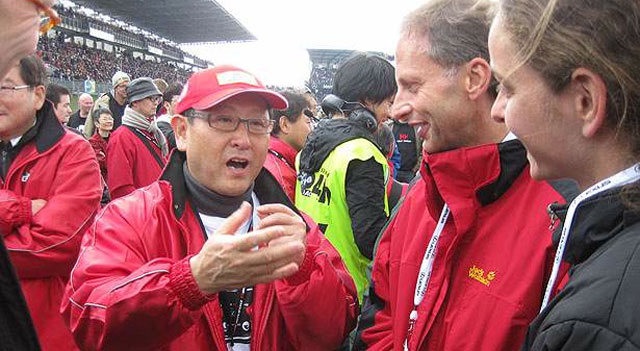
Akio Toyoda Profile
 Some quotes from the article in Automtive news:
[...]Toyoda embarked on a quest to become one of the company’s top certified test drivers and its top car critic. That challenge and journey combined to forge Toyoda’s management priorities, ones that now are reshaping Toyota in a time of crisis.
By getting behind the wheel and scrutinizing product, the 54-year-old Toyoda believes he is living out the company’s guiding principle: “Genchi, Genbutsu” — Japanese for “go and see for yourself.”
“Growth in itself is not bad if you can cultivate the human resources to keep up,” Toyoda said. “But I don’t want to be the largest company in the world. I want to be the best.”
Also in a related article in the same issue on the LFA race team at Nurburgring:
With 15 minutes left in the race, the crews of all teams crowd the outer pit wall to cheer on their drivers. In front of the Gazoo Racing pit, shutterbug Akio is standing on the roof of the team’s signaling booth, snapping photos and waving his support.
A jubilant President Toyoda leads his team to the infield — breaking into sprints at times — and begins passing out Warsteiner beers and posing for team pictures. Then it’s back to the pits, where the entire team proceeds to shower one another with more champagne and beer. In a year of observing and chronicling Toyoda, I’ve never seen the president laugh, let alone smile, so much.
“We started from nothing just four years ago, and here we are today,” Toyoda said before being drenched in beer. “Our people are stronger; our cars are stronger. Our team really did a great job.”
And as the Lexus Enthusiast says:
There’s something so refreshing about President Toyoda’s passion — it’s so clear in everything he does, and it’s that sincerity that makes me so excited about the future of both Toyota & Lexus.
http://lexusenthusiast.com/2010/05/31/akio-toyoda-profile/
 Some quotes from the article in Automtive news:
[...]Toyoda embarked on a quest to become one of the company’s top certified test drivers and its top car critic. That challenge and journey combined to forge Toyoda’s management priorities, ones that now are reshaping Toyota in a time of crisis.
By getting behind the wheel and scrutinizing product, the 54-year-old Toyoda believes he is living out the company’s guiding principle: “Genchi, Genbutsu” — Japanese for “go and see for yourself.”
“Growth in itself is not bad if you can cultivate the human resources to keep up,” Toyoda said. “But I don’t want to be the largest company in the world. I want to be the best.”
Also in a related article in the same issue on the LFA race team at Nurburgring:
With 15 minutes left in the race, the crews of all teams crowd the outer pit wall to cheer on their drivers. In front of the Gazoo Racing pit, shutterbug Akio is standing on the roof of the team’s signaling booth, snapping photos and waving his support.
A jubilant President Toyoda leads his team to the infield — breaking into sprints at times — and begins passing out Warsteiner beers and posing for team pictures. Then it’s back to the pits, where the entire team proceeds to shower one another with more champagne and beer. In a year of observing and chronicling Toyoda, I’ve never seen the president laugh, let alone smile, so much.
“We started from nothing just four years ago, and here we are today,” Toyoda said before being drenched in beer. “Our people are stronger; our cars are stronger. Our team really did a great job.”
And as the Lexus Enthusiast says:
There’s something so refreshing about President Toyoda’s passion — it’s so clear in everything he does, and it’s that sincerity that makes me so excited about the future of both Toyota & Lexus.
http://lexusenthusiast.com/2010/05/31/akio-toyoda-profile/
Thursday, May 6, 2010
Sticking Accelerator pedals--DODGE--Where's Congress Now?
Here is an Article from Bloomberg News.... Boy talk about the double standard, no front pages here.\:
Chrysler Group LLC accelerator pedals made by the same company that supplied Toyota Motor Corp. are under investigation by U.S. automotive-safety regulators for potential cases of sticking in Dodge Caliber models.
The National Highway Traffic Safety Administration said in a Web site posting today it is looking into the pedals made by CTS Corp. for Chrysler’s 2007 model year Dodge Caliber, which includes about 161,000 vehicles. The agency said it received five complaints by consumers saying the pedals stuck while they were driving their vehicles.
“The company’s initial examination of customer complaints finds they are limited to a small group of vehicles built during a five-week window in March and April of 2006,” Chrysler spokesman Nick Cappa said in an e-mailed statement. “It appears to be a supplier manufacturing concern, which is mechanical in nature and not a design or electronic issue.”
About 10,000 vehicles for the 2007 model year were made with the batch of pedals containing the mechanical defect, Cappa said in an interview. The vehicles have brake-override technology, which is intended to stop a car if both the accelerator and brake are applied.
CTS, based in Elkhart, Indiana, also supplies pedals to Honda Motor Co., Nissan Motor Co. and Mitsubishi Motors Corp., according to the company’s chief executive officer. Mitchell Walorski, CTS director of planning and investor relations, didn’t respond to a telephone call seeking comment.
Honda’s ‘Own Design’
“We are not aware of any specific investigations involving Honda pedals,” said Chris Martin, a spokesman for Honda’s U.S. unit in Torrance, California. Pedals supplied by CTS for Honda vehicles are “our own design” and not the same as those used in Toyota models, Martin said.
No crashes or injuries have been attributed to the defect in the Chrysler vehicles, NHTSA said.
Toyota, the world’s largest automaker, has recalled 2.3 million vehicles in the U.S. because of accelerator pedals that may stick.
Customers who own a Caliber made during March or April 2006 may bring it to a Dodge dealer for a free accelerator pedal inspection, Chrysler said.
http://www.businessweek.com/news/2010-05-03/cts-pedals-on-chrysler-cars-investigated-for-sticking-update3-.html
Chrysler Group LLC accelerator pedals made by the same company that supplied Toyota Motor Corp. are under investigation by U.S. automotive-safety regulators for potential cases of sticking in Dodge Caliber models.
The National Highway Traffic Safety Administration said in a Web site posting today it is looking into the pedals made by CTS Corp. for Chrysler’s 2007 model year Dodge Caliber, which includes about 161,000 vehicles. The agency said it received five complaints by consumers saying the pedals stuck while they were driving their vehicles.
“The company’s initial examination of customer complaints finds they are limited to a small group of vehicles built during a five-week window in March and April of 2006,” Chrysler spokesman Nick Cappa said in an e-mailed statement. “It appears to be a supplier manufacturing concern, which is mechanical in nature and not a design or electronic issue.”
About 10,000 vehicles for the 2007 model year were made with the batch of pedals containing the mechanical defect, Cappa said in an interview. The vehicles have brake-override technology, which is intended to stop a car if both the accelerator and brake are applied.
CTS, based in Elkhart, Indiana, also supplies pedals to Honda Motor Co., Nissan Motor Co. and Mitsubishi Motors Corp., according to the company’s chief executive officer. Mitchell Walorski, CTS director of planning and investor relations, didn’t respond to a telephone call seeking comment.
Honda’s ‘Own Design’
“We are not aware of any specific investigations involving Honda pedals,” said Chris Martin, a spokesman for Honda’s U.S. unit in Torrance, California. Pedals supplied by CTS for Honda vehicles are “our own design” and not the same as those used in Toyota models, Martin said.
No crashes or injuries have been attributed to the defect in the Chrysler vehicles, NHTSA said.
Toyota, the world’s largest automaker, has recalled 2.3 million vehicles in the U.S. because of accelerator pedals that may stick.
Customers who own a Caliber made during March or April 2006 may bring it to a Dodge dealer for a free accelerator pedal inspection, Chrysler said.
http://www.businessweek.com/news/2010-05-03/cts-pedals-on-chrysler-cars-investigated-for-sticking-update3-.html
Tuesday, May 4, 2010
LEXUS LEAPS IN!!!!
Toyota sticks with its incentives; Lexus leaps in
Kathy Jackson Automotive News -- May 3, 2010 - 6:02 pm ET
LOS ANGELES -- Toyota Division will stick with aggressive consumer incentives this month in an effort to hang on to its sales momentum. Meanwhile, Lexus Division has come out with a program of special leases and low interest rates.In April, Toyota-Scion sales rose 24 percent over April 2009 to 139,080 cars and trucks. Lexus sales climbed 29 percent to 18,359.Toyota Division began offering incentives March 2 after worldwide recalls of more than 8 million vehicles to fix defects linked to unintended acceleration and to adjust brakes.The division will continue with cut-rate lease deals and 0 percent financing on its most popular models.
Meantime, Lexus is touting special leases and low annual percentage rate loyalty programs in a one-month promotion called "Unprecedented Access." Toyota Division chief Bob Carter said leasing represented about 35 percent of sales last month, up from about 24 percent earlier this year. He said leasing will continue to play a key role in the division's strategy in the coming months."It's a key benefit for us," Carter said during a sales call today. "Customers like to change vehicles. We believe this is a strategy that can benefit the entire industry."Retail sales for Toyota-Scion were up 30 percent over April 2009. Carter said conquest sales accounted for about 40 percent of the division's volume for the second straight month -- similar to conquest rates before the recalls."That shows consumers don't care about the deal if they don't trust a brand," he said.Carter said Toyota will stick with rebates and sales for the short term but this summer will return to marketing brand attributes.
Lexus Division General Manager Mark Templin said the luxury brand's strong sales are a sign of economic recovery."There's a lot of momentum in the marketplace," he said. Templin said Lexus usually has a 20-day supply of vehicles, but production will be ramped up to achieve a 35-day supply.Meanwhile, Templin said more than 75 percent of Lexus' GX 460 inventory has been updated with new software to address a problem that could cause the vehicle to roll over.
Read more: http://www.autonews.com/apps/pbcs.dll/article?AID=/20100503/RETAIL01/100509957/1290#ixzz0myNfqogD
Kathy Jackson Automotive News -- May 3, 2010 - 6:02 pm ET
LOS ANGELES -- Toyota Division will stick with aggressive consumer incentives this month in an effort to hang on to its sales momentum. Meanwhile, Lexus Division has come out with a program of special leases and low interest rates.In April, Toyota-Scion sales rose 24 percent over April 2009 to 139,080 cars and trucks. Lexus sales climbed 29 percent to 18,359.Toyota Division began offering incentives March 2 after worldwide recalls of more than 8 million vehicles to fix defects linked to unintended acceleration and to adjust brakes.The division will continue with cut-rate lease deals and 0 percent financing on its most popular models.
Meantime, Lexus is touting special leases and low annual percentage rate loyalty programs in a one-month promotion called "Unprecedented Access." Toyota Division chief Bob Carter said leasing represented about 35 percent of sales last month, up from about 24 percent earlier this year. He said leasing will continue to play a key role in the division's strategy in the coming months."It's a key benefit for us," Carter said during a sales call today. "Customers like to change vehicles. We believe this is a strategy that can benefit the entire industry."Retail sales for Toyota-Scion were up 30 percent over April 2009. Carter said conquest sales accounted for about 40 percent of the division's volume for the second straight month -- similar to conquest rates before the recalls."That shows consumers don't care about the deal if they don't trust a brand," he said.Carter said Toyota will stick with rebates and sales for the short term but this summer will return to marketing brand attributes.
Lexus Division General Manager Mark Templin said the luxury brand's strong sales are a sign of economic recovery."There's a lot of momentum in the marketplace," he said. Templin said Lexus usually has a 20-day supply of vehicles, but production will be ramped up to achieve a 35-day supply.Meanwhile, Templin said more than 75 percent of Lexus' GX 460 inventory has been updated with new software to address a problem that could cause the vehicle to roll over.
Read more: http://www.autonews.com/apps/pbcs.dll/article?AID=/20100503/RETAIL01/100509957/1290#ixzz0myNfqogD
Monday, May 3, 2010
Toyota Team Members Write a Book--Put it on your must read lis!
Tim Turner, a Toyota team member at the Georgetown, Ky., assembly plant, wanted to tell Americans about the great people who work with him at Toyota. So he decided to write a book, and he enlisted his colleagues to help him.
He began approaching fellow team members and asking them to write short stories about their experiences at Toyota. The response surprised even Turner. During one three-month period, he told the Lexington Herald-Leader, he was receiving a new story a day. Some of the stories make you cry, the paper quoted one team member as saying, and some make you laugh.
The 430-page book, "One Team on All Levels: The Story of the Toyota Team Members," sells for $15.95 on Amazon.com. Proceeds from the book’s sales go to support the plant’s team member assistance fund.
http://www.kentucky.com/2010/05/03/1249182/it-takes-teamwork-to-write-book.html
He began approaching fellow team members and asking them to write short stories about their experiences at Toyota. The response surprised even Turner. During one three-month period, he told the Lexington Herald-Leader, he was receiving a new story a day. Some of the stories make you cry, the paper quoted one team member as saying, and some make you laugh.
The 430-page book, "One Team on All Levels: The Story of the Toyota Team Members," sells for $15.95 on Amazon.com. Proceeds from the book’s sales go to support the plant’s team member assistance fund.
http://www.kentucky.com/2010/05/03/1249182/it-takes-teamwork-to-write-book.html
Friday, April 16, 2010
Toyota's Detractors...most disliked
Forbes.com
Toyotas Kipling Moment: The only good news for the automaker is that its detractors are among the most disliked institutions in the nation.
Forbes.coms Jerry Flint reports that Toyota electrical glitches are unlikely and that drivers error is more likely. Additionally, he reports, that in Toyotas favor is the fact that the opposition is extremely untrustworthy in the eyes of the American public.
Quotes from the story:
If it finds an actual problem, Toyota can fix it once and for all. But if they can't find a problem, if no one can find a problem, if it seems to be driver error--stepping on the accelerator instead of the brake--then the questions go on and on. People in accidents will continue to believe they did nothing wrong, lawyers will continue to file suits, the press will continue to regurgitate the same stories day after day and Toyota will stay in the hole.
The other day I had a chat with a car tester, one of the best known car testers in the world. I guarantee he's not in Toyota's pocket, or anyone else's. I asked him about the unintended acceleration complaints against Toyota. He said he believed that for the most part they were drivers' errors. Why? He had never run into them in all his testing. But more important, he said that if there were an electronic glitch, it would have shown up in many other ways: headlights flickering on and off and radios going on and off. That's because the electronics are interconnected. If this isn't happening, and we don't hear such reports, then the premise that unintended acceleration is being caused by an electronic glitch is questionable, he said.
But Toyota has this going for it: the question of who people will trust more, the automaker or its detractors. The detractors are Congress, trial lawyers and the press, three of the most distrusted groups in the nation, while the car company has millions of satisfied owners out there. We know because they keep turning in their old Toyotas and buying new ones.
http://www.forbes.com/2010/04/14/toyota-lexus-prius-business-autos-toyota.html?boxes=businesschannelsections
Toyotas Kipling Moment: The only good news for the automaker is that its detractors are among the most disliked institutions in the nation.
Forbes.coms Jerry Flint reports that Toyota electrical glitches are unlikely and that drivers error is more likely. Additionally, he reports, that in Toyotas favor is the fact that the opposition is extremely untrustworthy in the eyes of the American public.
Quotes from the story:
If it finds an actual problem, Toyota can fix it once and for all. But if they can't find a problem, if no one can find a problem, if it seems to be driver error--stepping on the accelerator instead of the brake--then the questions go on and on. People in accidents will continue to believe they did nothing wrong, lawyers will continue to file suits, the press will continue to regurgitate the same stories day after day and Toyota will stay in the hole.
The other day I had a chat with a car tester, one of the best known car testers in the world. I guarantee he's not in Toyota's pocket, or anyone else's. I asked him about the unintended acceleration complaints against Toyota. He said he believed that for the most part they were drivers' errors. Why? He had never run into them in all his testing. But more important, he said that if there were an electronic glitch, it would have shown up in many other ways: headlights flickering on and off and radios going on and off. That's because the electronics are interconnected. If this isn't happening, and we don't hear such reports, then the premise that unintended acceleration is being caused by an electronic glitch is questionable, he said.
But Toyota has this going for it: the question of who people will trust more, the automaker or its detractors. The detractors are Congress, trial lawyers and the press, three of the most distrusted groups in the nation, while the car company has millions of satisfied owners out there. We know because they keep turning in their old Toyotas and buying new ones.
http://www.forbes.com/2010/04/14/toyota-lexus-prius-business-autos-toyota.html?boxes=businesschannelsections
Wednesday, April 7, 2010
Toyota's Great Victory
Chattanoogan.com Roy Exum:
Editor Roy Exum, who has been following the Toyota recall controversy and is very much pro-Toyota, writes about the favorable sales numbers Toyota posted in March and how Toyota played a role in jump-starting sales for the automotive industry overall.
Quotes from the story:
Toyota Motor Company had an 87 percent sales increase in March over the month before and a 41 percent increase over March a year ago. Thats right, the same company so brutally and unfairly bashed in Congress this winter just sold more vehicles (186,000) last month than any other brand in the United States.
The incentives package offered by what I am now assured is the worlds safest and most reliable automobile have actually kick-started the economically-stalled automotive industry. Plainly put, all that a union-driven witch hunt could do to humiliate and defraud a great and noble global company just blew up in its face.
[I am] one of 200,000 Americans who today proudly wears a Toyota patch. I offer that not just as a disclaimer, but instead to say I have now seen an inside to a company that I candidly believe is one of the finest and most exciting in the world.
In short, Toyota did not only do the right thing, they went over and beyond it.
I have viable proof of the millions of dollars Toyota has given to this country in the form of youth ball fields, United Way, the Red Cross, you name it. At a time when we are praying daily for the unemployed and the uninsured, I can show you 200,000 fiercely-loyal Americans who are being treated in such a way they will literally do anything as long as its legal to prove Toyota is, quite simply, the best.
http://www.chattanoogan.com/articles/article_172625.asp
Editor Roy Exum, who has been following the Toyota recall controversy and is very much pro-Toyota, writes about the favorable sales numbers Toyota posted in March and how Toyota played a role in jump-starting sales for the automotive industry overall.
Quotes from the story:
Toyota Motor Company had an 87 percent sales increase in March over the month before and a 41 percent increase over March a year ago. Thats right, the same company so brutally and unfairly bashed in Congress this winter just sold more vehicles (186,000) last month than any other brand in the United States.
The incentives package offered by what I am now assured is the worlds safest and most reliable automobile have actually kick-started the economically-stalled automotive industry. Plainly put, all that a union-driven witch hunt could do to humiliate and defraud a great and noble global company just blew up in its face.
[I am] one of 200,000 Americans who today proudly wears a Toyota patch. I offer that not just as a disclaimer, but instead to say I have now seen an inside to a company that I candidly believe is one of the finest and most exciting in the world.
In short, Toyota did not only do the right thing, they went over and beyond it.
I have viable proof of the millions of dollars Toyota has given to this country in the form of youth ball fields, United Way, the Red Cross, you name it. At a time when we are praying daily for the unemployed and the uninsured, I can show you 200,000 fiercely-loyal Americans who are being treated in such a way they will literally do anything as long as its legal to prove Toyota is, quite simply, the best.
http://www.chattanoogan.com/articles/article_172625.asp
Thursday, April 1, 2010
Who Makes the Toughest Cars on the Planet
Forbes.com Toughest Cars On The Road
Hannah Elliot combines the results of J.D. Power and Consumer Reports to determine the toughest cars on the road results show two Lexus models among the top contenders.
Quotes from the story:
Anxious drivers may take comfort that the Toyota Prius--at the center of dozens of lawsuits blaming the company for traffic fatalities due to alleged unintended acceleration--is among the countrys sturdiest cars.
Two more Toyota owned models, the $37,625 Lexus RX SUV and $65,380 Lexus LS 460 sedan, are also among the toughest cars on the road.
To compile our list, we started with the results of J.D. Power's 2010 Dependability Study, released this month. We took the top three vehicles listed in each segment and whittled down contenders by selecting only those that Consumer Reports labeled "Most Reliable" in a survey issued in its April 2010 issue. We then eliminated any vehicles with an overall CR score lower than 75.
http://www.forbes.com/2010/03/29/toyota-prius-power-lifestyle-vehicles-toughest-cars.html
Hannah Elliot combines the results of J.D. Power and Consumer Reports to determine the toughest cars on the road results show two Lexus models among the top contenders.
Quotes from the story:
Anxious drivers may take comfort that the Toyota Prius--at the center of dozens of lawsuits blaming the company for traffic fatalities due to alleged unintended acceleration--is among the countrys sturdiest cars.
Two more Toyota owned models, the $37,625 Lexus RX SUV and $65,380 Lexus LS 460 sedan, are also among the toughest cars on the road.
To compile our list, we started with the results of J.D. Power's 2010 Dependability Study, released this month. We took the top three vehicles listed in each segment and whittled down contenders by selecting only those that Consumer Reports labeled "Most Reliable" in a survey issued in its April 2010 issue. We then eliminated any vehicles with an overall CR score lower than 75.
http://www.forbes.com/2010/03/29/toyota-prius-power-lifestyle-vehicles-toughest-cars.html
Tuesday, March 30, 2010
What's Really Driving the Toyota Controversy?
WashingtonExaminer.com
In this opinion article by Don Watkins and Yaron Brook, the authors reveal some behind-the-scenes players that may be fueling the fire of the Toyota recalls.
Quotes from the story:
In February, Toyota executives were hauled in front of Congress, purportedly so that renowned auto experts like House Energy and Commerce Committee Chairman Henry Waxman of California could determine the cause of reported cases of unintended acceleration and evaluate Toyotas alleged failure to respond. The hearings had the fingerprints of politics all over them.
The Detroit lobby is hard to distinguish from the government itself now that the government holds a 60 percent stake in General Motors. Even if concerns about an electronic problem in Toyotas vehicles turn out to be baseless, domestic manufacturers stand to benefit by prolonging the parade of bad publicity.
Anyone who thinks Toyotas executives were summoned to Congress to discuss the evidence concerning Toyotas vehicles has missed the point. Regardless of what we ultimately discover about Toyota, this was about a horde of pressure groups seeking to impose their economic agendas via political power.
The cause is the governments power to intervene in the market to pick winners and losers. In the auto industry alone, the government controls everything from whom car companies can hire (unionized employees) to what kind of vehicles they must build (hybrids). The truth is Toyotas troubles should not be a political issue.
http://www.washingtonexaminer.com/opinion/columns/OpEd-Contributor/Don-Watkins-and-Yaron-Brook-Whats-really-driving-the-Toyota-controversy-89271207.html
In this opinion article by Don Watkins and Yaron Brook, the authors reveal some behind-the-scenes players that may be fueling the fire of the Toyota recalls.
Quotes from the story:
In February, Toyota executives were hauled in front of Congress, purportedly so that renowned auto experts like House Energy and Commerce Committee Chairman Henry Waxman of California could determine the cause of reported cases of unintended acceleration and evaluate Toyotas alleged failure to respond. The hearings had the fingerprints of politics all over them.
The Detroit lobby is hard to distinguish from the government itself now that the government holds a 60 percent stake in General Motors. Even if concerns about an electronic problem in Toyotas vehicles turn out to be baseless, domestic manufacturers stand to benefit by prolonging the parade of bad publicity.
Anyone who thinks Toyotas executives were summoned to Congress to discuss the evidence concerning Toyotas vehicles has missed the point. Regardless of what we ultimately discover about Toyota, this was about a horde of pressure groups seeking to impose their economic agendas via political power.
The cause is the governments power to intervene in the market to pick winners and losers. In the auto industry alone, the government controls everything from whom car companies can hire (unionized employees) to what kind of vehicles they must build (hybrids). The truth is Toyotas troubles should not be a political issue.
http://www.washingtonexaminer.com/opinion/columns/OpEd-Contributor/Don-Watkins-and-Yaron-Brook-Whats-really-driving-the-Toyota-controversy-89271207.html
Friday, March 26, 2010
“Complaints beget complaints.”
Wall Street Journal Columnist Questions Toyota’s “Mysteriously High Level” of Acceleration Complaints :
In today’s Wall Street Journal, columnist Holman Jenkins addresses Toyota’s “mysteriously high level” of unintended acceleration complaints compared to most car makers. “One pattern…is unmistakable,” Jenkins notes, commenting on the widespread press coverage of Toyota’s recalls and reflecting back on the situation with Audi more than 20 years ago. “Complaints beget complaints.”
Jenkins notes.
“Perceptions that Toyotas are unusually unsafe may be entirely a product of a ‘complaint’ bandwagon…partly encouraged by trial lawyers and activists.”
Despite this, he writes, “careful studies by several governments, including the U.S. government, concluded there was no defect behind” the earlier Audi acceleration complaints.
Jenkins also notes that since 2001, trial lawyers have been “urging a revival of sudden unintended acceleration litigation, insisting that such cases could prevail in absence of evidence of a defect, and even amid evidence of driver error, simply by harping in front of a jury on a record of ‘Other Similar Incidents.’…“That’s the roadmap being followed now.” Toyota is not the first target of this kind of campaign, the Journal points out. In fact, “a 10-year battle against Ford over a 1999 Aerostar minivan crash ended four weeks ago when a jury rendered a verdict in favor of Ford after just two hours of deliberation.”
In today’s Wall Street Journal, columnist Holman Jenkins addresses Toyota’s “mysteriously high level” of unintended acceleration complaints compared to most car makers. “One pattern…is unmistakable,” Jenkins notes, commenting on the widespread press coverage of Toyota’s recalls and reflecting back on the situation with Audi more than 20 years ago. “Complaints beget complaints.”
Jenkins notes.
“Perceptions that Toyotas are unusually unsafe may be entirely a product of a ‘complaint’ bandwagon…partly encouraged by trial lawyers and activists.”
Despite this, he writes, “careful studies by several governments, including the U.S. government, concluded there was no defect behind” the earlier Audi acceleration complaints.
Jenkins also notes that since 2001, trial lawyers have been “urging a revival of sudden unintended acceleration litigation, insisting that such cases could prevail in absence of evidence of a defect, and even amid evidence of driver error, simply by harping in front of a jury on a record of ‘Other Similar Incidents.’…“That’s the roadmap being followed now.” Toyota is not the first target of this kind of campaign, the Journal points out. In fact, “a 10-year battle against Ford over a 1999 Aerostar minivan crash ended four weeks ago when a jury rendered a verdict in favor of Ford after just two hours of deliberation.”
Thursday, March 25, 2010
Actions Speak Louder than Words
"Actions Speak Louder than Words”
“Many consumers tell us over and again that they believe Toyota has been over-scrutinized and that they remain very confident in the safety of our products – as are we,” wrote TMS Vice President Michael Rouse in a new public posting on the Toyota USA Newsroom web site.
Describing the steps that Toyota has taken to make things right, Rouse wrote that, “Actions speak louder than words,” noting that the company and its dealers:
· Made more than 1.5 million combined recall repairs; (I'd like to see any other manufacture do so well and so quick)
· Launched an independent external review of vehicle
electronics; (when was the last time Detroit did that? or will? Never)and
· Continue to make fundamental changes to the ways the company
operates to be even more responsive to customers.
In addition, Rouse noted, “There has been a great deal of confusion, speculation and misinformation about our recent recalls – much of it in the media or as a result of unsupported claims about ‘unintended acceleration’ caused by our electronics,” Rouse explained. This is a complex issue, he wrote. Echoing a theme in a number of recent press reports and opinion columns recently, “Rushing to judgment on the basis of unfounded theories is a disservice.”
To read Michael Rouse’s complete posting, please click on
http://pressroom.toyota.com/pr/tms/our-point-of-view-post.aspx?id=2837
“Many consumers tell us over and again that they believe Toyota has been over-scrutinized and that they remain very confident in the safety of our products – as are we,” wrote TMS Vice President Michael Rouse in a new public posting on the Toyota USA Newsroom web site.
Describing the steps that Toyota has taken to make things right, Rouse wrote that, “Actions speak louder than words,” noting that the company and its dealers:
· Made more than 1.5 million combined recall repairs; (I'd like to see any other manufacture do so well and so quick)
· Launched an independent external review of vehicle
electronics; (when was the last time Detroit did that? or will? Never)and
· Continue to make fundamental changes to the ways the company
operates to be even more responsive to customers.
In addition, Rouse noted, “There has been a great deal of confusion, speculation and misinformation about our recent recalls – much of it in the media or as a result of unsupported claims about ‘unintended acceleration’ caused by our electronics,” Rouse explained. This is a complex issue, he wrote. Echoing a theme in a number of recent press reports and opinion columns recently, “Rushing to judgment on the basis of unfounded theories is a disservice.”
To read Michael Rouse’s complete posting, please click on
http://pressroom.toyota.com/pr/tms/our-point-of-view-post.aspx?id=2837
Wednesday, March 24, 2010
Toyota, Flying Saucers and Bigfoot
Columnist Jerry Flint Criticizes the Media for Uncritical Look at Complaints About Toyotas
Under the headline "Toyota, Flying Saucers and Bigfoot" Tuesday, Forbes columnist Jerry Flint took members of the media to task Tuesday for accepting as real the claims of runaway Toyotas "without serious questioning."
"Toyota has had a bit of good news in recent days. One of the claims of unintended acceleration has begun to look like a phony."
"Then The New York Times ran an op-ed piece by a UCLA psychology professor (emeritus) questioning all such claims. The writer, who had worked on the issue years ago, wrote that they were usually driver error--stepping on the accelerator pedal instead of the brakes--and noting that older drivers tend to make these mistakes more often."
Flint also shared a few of his thoughts about why so many new complaints are being filed and what the long-term impact may be on Toyota. In addition to drivers putting their foot on the wrong pedal and "dreams of the big payoff" from a lawsuit, Flint suggested that people’s feet may simply be getting bigger. "Maybe these bigger feet overlap" the brake and gas pedals, he said. As for how all this will impact Toyota, Flint said the company "might spend more money on lawyers over the next few years than on developing fuel-stingy engines."
To read the entire column, click on
http://www.forbes.com/2010/03/23/toyota-autos-brakes-business-backseat-safety.html
Under the headline "Toyota, Flying Saucers and Bigfoot" Tuesday, Forbes columnist Jerry Flint took members of the media to task Tuesday for accepting as real the claims of runaway Toyotas "without serious questioning."
"Toyota has had a bit of good news in recent days. One of the claims of unintended acceleration has begun to look like a phony."
"Then The New York Times ran an op-ed piece by a UCLA psychology professor (emeritus) questioning all such claims. The writer, who had worked on the issue years ago, wrote that they were usually driver error--stepping on the accelerator pedal instead of the brakes--and noting that older drivers tend to make these mistakes more often."
Flint also shared a few of his thoughts about why so many new complaints are being filed and what the long-term impact may be on Toyota. In addition to drivers putting their foot on the wrong pedal and "dreams of the big payoff" from a lawsuit, Flint suggested that people’s feet may simply be getting bigger. "Maybe these bigger feet overlap" the brake and gas pedals, he said. As for how all this will impact Toyota, Flint said the company "might spend more money on lawyers over the next few years than on developing fuel-stingy engines."
To read the entire column, click on
http://www.forbes.com/2010/03/23/toyota-autos-brakes-business-backseat-safety.html
Tuesday, March 23, 2010
JD Powers: Toyota has more first place awards than anyone this year
Toyota Happy With JD Power Survey Results
Based on comments made by Toyota, this article reports that the company is happy with the results of the JD Power and Associates survey results.
Quotes from the story:
We are pleased that TMS has once again led the way with the most segment awards in the J.D. Power Vehicle Dependability Study. Were especially proud of our consistency in the annual study. Since 1994 Lexus has continued to place among the top three nameplates in every year of eligibility, while Toyota has been in the top five among non-luxury manufacturers since 1990.
Toyota has once again topped this years study as the top-ranking full-line manufacturer, said Jim Lentz, president of Toyota Motor Sales (TMS), U.S.A., Inc.
Other examples of Toyotas commitment to excellence, quality products and customer satisfaction include:
Toyota received four 1st place awards more than any other brand.
18 Toyota, Lexus and Scion vehicles made the list of Most Reliable New Car in 10 different vehicle categories by a leading national consumer publication.
Toyota owner loyalty remains the highest in the industry, according to internal studies.
The Tundra full-size pickup and the GX 470 midsize premium SUV each topped its respective segments for the fifth year in a row.
The Highlander midsize SUV and Sequoia full-size SUV each topped their respective segments for the third consecutive year.
http://www.autoevolution.com/news/toyota-happy-with-jd-power-survey-results-18234.html
Based on comments made by Toyota, this article reports that the company is happy with the results of the JD Power and Associates survey results.
Quotes from the story:
We are pleased that TMS has once again led the way with the most segment awards in the J.D. Power Vehicle Dependability Study. Were especially proud of our consistency in the annual study. Since 1994 Lexus has continued to place among the top three nameplates in every year of eligibility, while Toyota has been in the top five among non-luxury manufacturers since 1990.
Toyota has once again topped this years study as the top-ranking full-line manufacturer, said Jim Lentz, president of Toyota Motor Sales (TMS), U.S.A., Inc.
Other examples of Toyotas commitment to excellence, quality products and customer satisfaction include:
Toyota received four 1st place awards more than any other brand.
18 Toyota, Lexus and Scion vehicles made the list of Most Reliable New Car in 10 different vehicle categories by a leading national consumer publication.
Toyota owner loyalty remains the highest in the industry, according to internal studies.
The Tundra full-size pickup and the GX 470 midsize premium SUV each topped its respective segments for the fifth year in a row.
The Highlander midsize SUV and Sequoia full-size SUV each topped their respective segments for the third consecutive year.
http://www.autoevolution.com/news/toyota-happy-with-jd-power-survey-results-18234.html
People, Not Cars, Were to Blame--Research from NPR
Runaway Cars: Driver Error Or Car Malfunction?
Alix Spiegel of NPR reviews research performed by experts in the 80s that shows driver error contributes to sudden unintended acceleration.
Quotes from the story:
When this report on sudden acceleration finally came out in 1989, its conclusions were unwavering: The problem was driver error. People, not cars, were to blame.
According to the research, they say, human beings have a long history of pushing the wrong pedal.
Richard Schmidt, a human performance psychologist at UCLA, combed through all the accident reports in the state of North Carolina for a seven-year period. He found regular reports of pedal error.
The perseveration response you just keep repeating the same error over and over and over again is particularly likely to happen when people have misdiagnosed the problem. For instance, they might believe that they are hitting the brake when they are in fact hitting the gas. Because their basic analysis is wrong, under stress which tends to make creative thinking difficult and narrows your field of attention they are liable to repeat and repeat that wrong action in an attempt to fix it.
http://www.npr.org/templates/story/story.php?storyId=124815144&ps=rs
Alix Spiegel of NPR reviews research performed by experts in the 80s that shows driver error contributes to sudden unintended acceleration.
Quotes from the story:
When this report on sudden acceleration finally came out in 1989, its conclusions were unwavering: The problem was driver error. People, not cars, were to blame.
According to the research, they say, human beings have a long history of pushing the wrong pedal.
Richard Schmidt, a human performance psychologist at UCLA, combed through all the accident reports in the state of North Carolina for a seven-year period. He found regular reports of pedal error.
The perseveration response you just keep repeating the same error over and over and over again is particularly likely to happen when people have misdiagnosed the problem. For instance, they might believe that they are hitting the brake when they are in fact hitting the gas. Because their basic analysis is wrong, under stress which tends to make creative thinking difficult and narrows your field of attention they are liable to repeat and repeat that wrong action in an attempt to fix it.
http://www.npr.org/templates/story/story.php?storyId=124815144&ps=rs
Toyota Hysteria: Who's Fault is it Really?
Toyota hysteria: Horror stories really about us
As a follow up to the article he wrote for Forbes.com, Michael Fumento explains that the Toyota crisis is the result of media blowing things out of proportion.
Quotes from the story:
The mass reports of sudden-acceleration incidents just don't add up. Measured by reports to the National Highway Safety Administration, these same Toyotas were actually safe just a few months ago. And overseas they still are.
Clearly, the biggest cause of Toyota sudden-acceleration complaints is media coverage.
The NHTSA gets a constant stream of "speed control" complaints regarding every model of car. A recent New York Times analysis found almost 13,000 over the last decade (of which 10,000 didn't involve Toyotas).
People who cause accidents -- especially serious ones -- understandably want to blame something other than themselves. Sudden unintended acceleration does the trick.
http://www.nypost.com/p/news/opinion/opedcolumnists/toyota_hysteria_fkQ7bahdNpTHOyesUuyGRJ
As a follow up to the article he wrote for Forbes.com, Michael Fumento explains that the Toyota crisis is the result of media blowing things out of proportion.
Quotes from the story:
The mass reports of sudden-acceleration incidents just don't add up. Measured by reports to the National Highway Safety Administration, these same Toyotas were actually safe just a few months ago. And overseas they still are.
Clearly, the biggest cause of Toyota sudden-acceleration complaints is media coverage.
The NHTSA gets a constant stream of "speed control" complaints regarding every model of car. A recent New York Times analysis found almost 13,000 over the last decade (of which 10,000 didn't involve Toyotas).
People who cause accidents -- especially serious ones -- understandably want to blame something other than themselves. Sudden unintended acceleration does the trick.
http://www.nypost.com/p/news/opinion/opedcolumnists/toyota_hysteria_fkQ7bahdNpTHOyesUuyGRJ
Subscribe to:
Posts (Atom)